

Business Impact through Workflow Automation in Dynamics 365 Field Service

Table of Contents
Introduction
The field service management industry is undergoing a fundamental transformation. With the global FSM market projected to grow from $5 billion in 2025 to nearly $15 billion by 2035—representing a robust 11-12% CAGR—organizations are racing to automate workflows, optimize technician scheduling, and deliver AI-powered service experiences that drive measurable business outcomes.
At the center of this transformation is Dynamics 365 Field Service, Microsoft’s market-leading field service management solution that has evolved far beyond traditional work order management. In 2026, Dynamics 365 Field Service represents a complete platform for intelligent service operations—combining AI-powered scheduling agents, Copilot assistance, seamless Microsoft 365 integration, and powerful workflow automation through Power Automate.
The 2025 Release Wave 2 (October 2025 – March 2026) introduces game-changing capabilities including the new Scheduling Optimization Agent, enhanced mobile experiences with offline sync telemetry, and deeper integration with Teams, Outlook, and Viva Connections. These innovations help organizations shift from reactive, paper-based service to proactive, predictive operations—achieving higher first-time fix rates, reducing technician travel time, and unlocking new outcome-based service models.
This comprehensive guide explores how workflow automation in Dynamics 365 Field Service can transform your service operations in 2026, with practical insights on implementing AI-driven scheduling, Copilot-assisted workflows, and integration patterns that deliver measurable ROI.
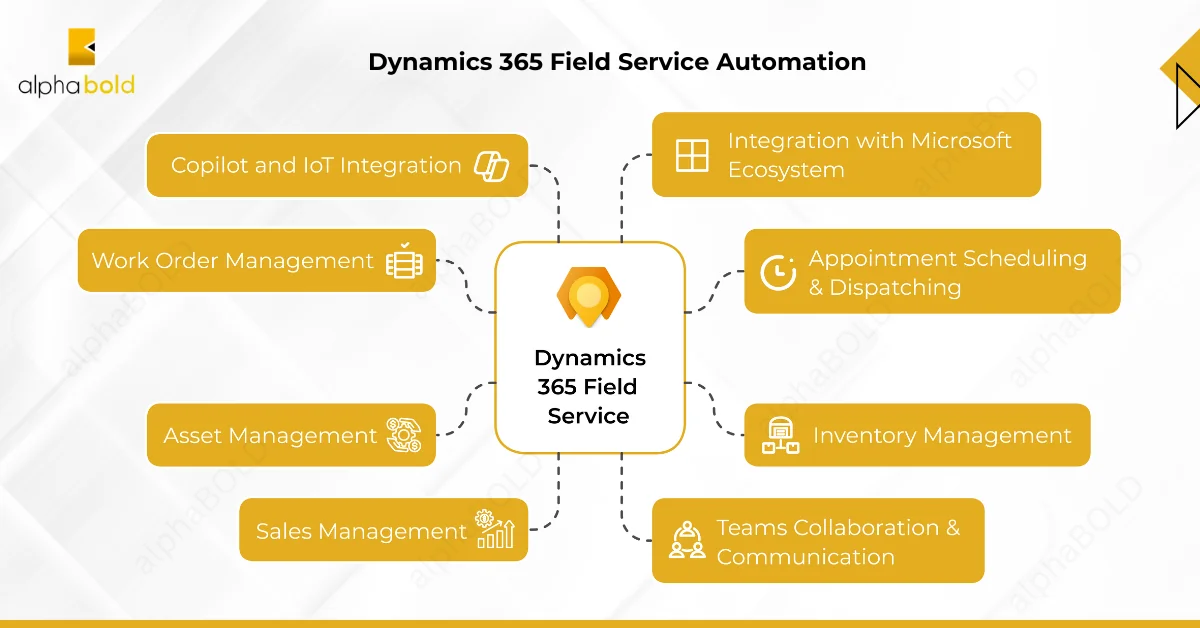
AI-Powered Scheduling and the Scheduling Optimization Agent
Resource scheduling is at the heart of field service management—and it’s also where organizations lose the most time and money when done manually. Microsoft’s 2025-2026 release waves have introduced significant advances in automated and AI-powered scheduling that fundamentally change how dispatchers and service managers operate.
The Evolution: From RSO to AI Scheduling
Dynamics 365 Field Service offers three scheduling approaches, each with increasing levels of intelligence:
- Manual Scheduling: Dispatchers drag and drop work orders on the schedule board—suitable for low volumes or emergency situations
- Schedule Assistant: Semi-automated tool that recommends resources based on availability, skills, and location
- Resource Scheduling Optimization (RSO): Automated bulk scheduling that optimizes routes and resource utilization based on defined goals
- AI Scheduling Agent: Predictive, real-time optimization that adapts instantly to changes using machine learning
AI Scheduling vs Traditional RSO: Key Differences
| Capability | Traditional RSO | AI Scheduling Agent |
|---|---|---|
|
Optimization Method |
Rules-based algorithms |
Predictive ML models |
|
Real-Time Adaptation |
Scheduled batch runs |
Instant intraday optimization |
|
Traffic/Weather |
Static route calculations |
Static route calculations |
|
Best For |
Overnight bulk scheduling |
Dynamic, high-volume operations |
Key Business Impact: Organizations implementing AI-powered scheduling report 22% improvements in first-time fix rates and 30% reduction in downtime through predictive maintenance and optimized routing.
Experience Automation in Action
Discover firsthand how Automation in Dynamics 365 Field Service can streamline your operations through automation. Our experts will guide you through its features and benefits.
Request a ConsultationCopilot-Powered Workflow Automation in 2026
Microsoft Copilot has transformed how organizations build and manage workflow automation. In 2026, you no longer need deep technical expertise to create sophisticated automated processes—you can describe what you need in natural language.
Copilot in Power Automate: Natural Language Automation
Power Automate’s Copilot capabilities allow you to:
- Create flows using conversation: Describe your automation in plain English, and Copilot generates the flow structure
- Setup time reduction: AI-powered flow creation cuts setup time by up to 70%
- Automatic connections: Copilot sets up connections to Field Service, SharePoint, Teams, and other services automatically
- Expression assistance: Copilot-assisted expression editing generates complex formulas without manual coding
2025 Release Wave Features for Field Service Automation
Generative Actions: The April 2025 wave introduced AI-driven steps that can be embedded natively within flows—automated summary generation, data enrichment, and next-best-action suggestions based on historical patterns.
Intelligent Document Processing: Extract data from work orders, service reports, and forms with 90%+ accuracy, then automatically route for processing.
Workflows Agent: The new Workflows agent in Microsoft 365 Copilot converts natural language requests into automated flows across Outlook, Teams, SharePoint, and Planner—no separate app required.
Example: Field Service Workflow Automation with Copilot
Scenario: “When a work order is completed, summarize the service notes, update the customer record, and send a satisfaction survey.”
With Copilot, you simply describe this scenario, and the system automatically:
- Creates a trigger when work order status changes to “Completed”
- Adds a Copilot action to summarize service notes using AI
- Updates the customer record in Dataverse
- Sends a personalized email with Microsoft Forms survey
Dynamics 365 Field Service 2025-2026 Release Highlights
Microsoft’s 2025 Release Waves deliver major investments across agent innovation, scheduling optimization, and technician productivity:
Technician Productivity Enhancements:
- Enhanced Mobile App: Rich offline capabilities with new Azure Application Insights telemetry for monitoring sync performance
- Selective Column Sync: Choose which fields sync offline to reduce payload size and improve performance
- Copilot for Technicians: AI assistance for troubleshooting, parts lookup, and service documentation
Microsoft 365 Integration:
- Teams Integration: Manage work orders and bookings directly within Microsoft Teams
- Outlook Copilot Prompts: Respond to customer emails with Field Service-specific AI suggestions
- Viva Connections: Frontline workers start their day with personalized dashboards showing today’s schedule
Work Order Management:
- Streamlined Workflows: Copilot assistance helps service managers allocate resources, coordinate schedules, and monitor progress
- Advanced Analytics: Power BI integration for analyzing feedback, metrics, and identifying improvement areas
- Project Operations Integration: Deeper connectivity for project-based field service scenarios
Important Note: Microsoft announced deprecation of several integrations (Outlook Add-in, standalone Teams app, Planner) after October 30, 2025, in favor of a more unified Field Service experience within Microsoft 365. Plan your transition accordingly.
Field Service Management Market in 2026 – Why Automation Matters
The business case for workflow automation in field service has never been stronger:
Market Growth Statistics:
- FSM Market Size: $5.1-5.6 billion in 2025, projected to reach $9.2-14.6 billion by 2030-2035
- Growth Rate: 11-16% CAGR depending on market segment
- SME Adoption: 54% of FSM market revenue from small and medium enterprises
- Mobile Adoption: 99% of field service organizations now use mobile FSM platforms
ROI from Workflow Automation:
| Metric | Improvement |
|---|---|
|
First-time fix rates |
+22% |
|
Customer retention rates |
+18% |
|
Service operation costs |
-14-18% |
|
Administrative overhead |
-21% |
|
Parts overstocking reduction |
-23% |
|
Technicians arriving without needed equipment |
-34% |
|
Downtime reduction (AI predictive maintenance) |
-30% |
Industry Technology Trends:
- oT Integration: Predictive maintenance through connected sensors reduces unnecessary truck rolls
- AR/VR Guidance: Remote visual assistance for technicians reducing service errors
- 5G Connectivity: Real-time data streaming enabling 30-40% time savings in field operations
- Cloud Adoption: Services segment growing at 14.8% CAGR as organizations shift to SaaS platforms
Conclusion
Workflow automation in Dynamics 365 Field Service has evolved from a nice-to-have efficiency tool to a strategic imperative for competitive field service operations. With the FSM market projected to nearly triple by 2035, organizations that fail to automate will find themselves increasingly outpaced by competitors who leverage AI-powered scheduling, Copilot-assisted workflows, and intelligent resource optimization.
The 2025-2026 release waves have positioned Dynamics 365 Field Service at the forefront of this transformation:
- AI Scheduling Agent moves beyond rules-based optimization to predictive, real-time scheduling that adapts instantly to changing conditions
- Copilot Integration democratizes automation—anyone can create sophisticated workflows using natural language
- Microsoft 365 Integration keeps frontline workers in their flow of work, managing field service directly from Teams, Outlook, and Viva Connections
- Power Automate provides the backbone for connecting Field Service to your entire business ecosystem with 1,000+ connectors
The ROI case is compelling: organizations implementing comprehensive FSM automation report 22% higher first-time fix rates, 18% better customer retention, and 14-18% reduction in service operation costs. For a mid-sized field service operation, these improvements translate directly to revenue growth and competitive advantage.
The question is no longer whether to automate your field service workflows, but how quickly you can implement the intelligent automation capabilities that Dynamics 365 Field Service now offers.
Ready to transform your field service operations? Contact AlphaBold today for a personalized assessment of how Dynamics 365 Field Service workflow automation can drive measurable results for your organization.