Improving the Customer Journey with Dynamics 365 Customer Insights

Table of Contents
Introduction
Did you know that a customer’s journey with your brand is as critical as the product or service you offer? In 2026’s hyper-competitive business environment, the key to standing out lies in creating unparalleled, AI-powered customer experiences. This journey, spanning from the initial spark of awareness to the heights of post-purchase advocacy, is a complex yet vital aspect of business success. Microsoft’s Dynamics 365 Customer Insights is a game-changing tool designed to not only understand but also to enhance every step of this journey with cutting-edge AI capabilities. In this blog post, we’ll delve into how Dynamics 365 Customer Insights transforms customer interactions into meaningful relationships, ultimately driving superior business outcomes.
What is Dynamics 365 Customer Insights?
Dynamics 365 Customer Insights (formerly Dynamics 365 Marketing) is a comprehensive marketing automation and customer data platform that provides businesses with powerful tools to create, execute, and measure marketing campaigns. With features such as AI-driven segmentation, intelligent automation, multichannel marketing, and advanced analytics, D365 Customer Insights offers a holistic approach to enhancing the customer journey.
The platform now consists of two integrated components:
- Customer Insights – Data: A unified customer data platform (CDP) that consolidates data from multiple sources
- Customer Insights – Journeys: Real-time marketing orchestration that enables trigger-based customer journeys
What is a Customer Journey?
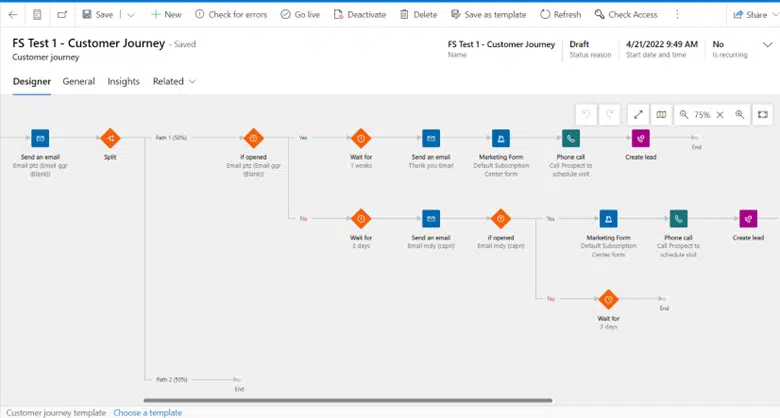
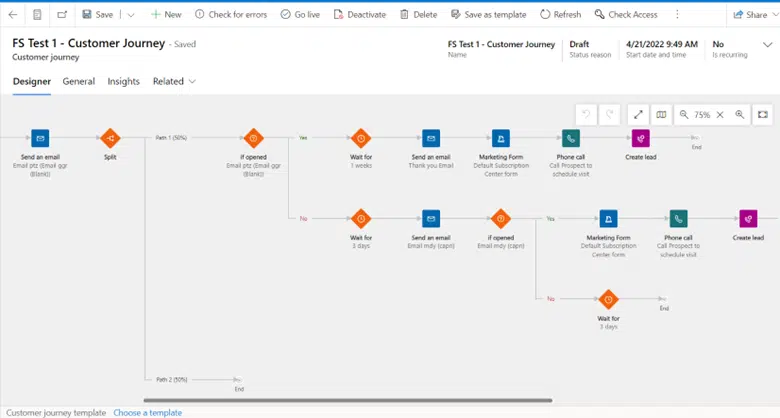
The concept of a customer journey encompasses the various stages a customer goes through in their interaction with a product or service. Recognizing and optimizing each of these stages is essential for a successful business strategy. Let’s break down these phases:
- Awareness: This initial phase is where a customer recognizes a need or problem and seeks information to address it. Here, your strategy should aim to boost awareness about your product or service among your target audience.
- Consideration: At this stage, prospects are actively evaluating your offering against others in the market. They are deeply involved in researching and comparing different solutions, including yours.
- Conversion: This critical phase involves persuading the customer to choose your offering. Effective calls to action are vital here, urging the customer to make a purchase or sign up for your service.
- Retention: A satisfied customer who finds ongoing value in your offering is more likely to remain loyal. This stage focuses on maintaining a consistent relationship with the customer, encouraging repeated business and purchases.
- Advocacy: The final stage is where a happy customer becomes a vocal advocate for your brand. They share their positive experiences through reviews, word-of-mouth marketing, and may participate in case studies or success stories, influencing other potential customers.
By understanding and strategically engaging with customers at each of these stages, you can create a more effective and cohesive journey that not only meets but exceeds customer expectations.
Incorporating Dynamics 365 Customer Journeys into your business strategy goes beyond traditional marketing approaches. This innovative tool, equipped with AI and natural language input assistance, empowers business users to create trigger-based journeys that effectively engage customers across various channels. These journeys play a crucial role in nurturing relationships, from prospecting to sales and support stages.
Let AlphaBOLD Handle Your Dynamics 365 Marketing
Sign up for a personalized demo based on your needs!
Request a DemoHow Dynamics 365 Customer Insights Transforms the Customer Journey
Incorporating Dynamics 365 Customer Insights into your business strategy goes beyond traditional marketing approaches. This innovative tool, equipped with AI and natural language input assistance, empowers business users to create trigger-based journeys that effectively engage customers across various channels. These journeys play a crucial role in nurturing relationships, from prospecting to sales and support stages.
Here’s how Dynamics 365 Customer Insights adds value:
1. AI-Powered Segmentation and Personalization:
Segmentation, profiling, and targeting are crucial for effective marketing campaigns. Dynamics 365 Customer Insights allows businesses to create hyper-personalized and targeted campaigns based on comprehensive customer data and AI-driven insights.
With the Query Assist feature powered by Copilot, marketers can effortlessly target the right audience by describing the segment in natural language. For example, simply type “people most likely to attend our product launch” and the AI will generate the appropriate segment.
Leveraging AI-driven recommendations, the tool transforms insights into action, tailoring content and channel strategies to each customer’s preferences, behaviors, and predicted needs. This goes beyond basic personalization to deliver situational personalization that adapts in real time to a customer’s goal, risk profile, and channel constraints.
2. Intelligent Marketing Automation:
Automation is a key feature of D365 Customer Insights that helps businesses streamline their marketing processes and improve efficiency. Businesses can automate tasks such as email marketing, lead nurturing, social media management, and campaign orchestration, saving time and resources while ensuring consistent messaging and customer experiences.
The 2025 Release Wave 2 introduces autonomous AI agents that work 24/7 to research and engage leads, drive purchase intent, and proactively bring key insights about emergent deal risks. This enables businesses to scale their marketing efforts exponentially and deliver a seamless customer journey across different touchpoints without manual intervention.
3. Real-Time Multichannel Marketing:
Today’s customers interact with businesses through multiple channels, such as email, social media, web, events, SMS, and even conversational AI interfaces. D365 Customer Insights supports real-time multichannel marketing, allowing companies to create consistent messaging and experiences across different channels while adapting to each channel’s unique characteristics.
The platform’s real-time journey orchestration responds to customer behaviors and triggers instantly, ensuring that customers receive the right message at precisely the right moment. This helps businesses create a cohesive customer journey and ensures that customers receive consistent brand messages and experiences, regardless of the channel they choose to engage with.
4. Advanced Customer Insights and Predictive Analytics:
Data-driven decision-making is crucial for optimizing marketing efforts and improving the customer journey. D365 Customer Insights provides businesses with actionable insights and predictive analytics to measure campaign success and forecast future customer behavior.
The platform employs AI-powered analytics to:
- Track key performance indicators (KPIs) such as open rates, click-through rates, conversion rates, and customer lifetime value
- Predict customer churn before it happens, enabling proactive retention strategies
- Identify high-value leads through intelligent scoring that considers historical data, customer activity, and engagement patterns
- Forecast demand and optimize campaign timing for maximum impact
- This enables businesses to continuously improve their marketing efforts and enhance the customer journey based on concrete data rather than assumptions.
5. Seamless Integration with Dynamics 365 Ecosystem:
D365 Customer Insights seamlessly integrates with other D365 applications, such as Dynamics 365 Sales and Customer Service, providing a unified view of customer interactions. This gives businesses a complete understanding of the customer journey, from marketing to sales to service, enabling them to deliver a consistent and personalized experience throughout the entire customer lifecycle.
This integration facilitates efficient collaboration and communication between marketing, sales, and service teams through shared customer profiles, interaction history, and AI-generated insights. The result is improved customer engagement, higher satisfaction scores, and increased revenue.
You may also like: Best Practices for Using Dynamics 365 Customer Insights – Journeys
AI Agents Revolutionizing Customer Engagement in 2026
One of the most significant developments in Dynamics 365 Customer Insights for 2026 is the introduction of autonomous AI agents that fundamentally transform how businesses engage with customers throughout their journey.
What Are AI Agents?
AI agents are intelligent, autonomous systems that can research, analyze, and act on customer data 24/7 without human intervention. Unlike traditional automation that follows pre-programmed rules, these agents use machine learning and generative AI to make contextual decisions and adapt to changing customer behaviors.
Key Capabilities of Dynamics 365 AI Agents:
Lead Research and Qualification: AI agents continuously monitor and research leads, gathering information from multiple sources including social media, company websites, news, and behavioral data. They automatically qualify leads based on engagement signals and buying intent, routing high-priority prospects to sales teams at the optimal moment.
Proactive Customer Engagement: Rather than waiting for customers to take action, AI agents proactively reach out with personalized messages when they detect buying signals or potential issues. For example, if a customer’s product usage patterns suggest they might benefit from an upgrade or need support, the agent initiates contact automatically.
Risk Detection and Mitigation: AI agents analyze customer behavior patterns to identify early warning signs of churn, dissatisfaction, or disengagement. They can automatically trigger retention campaigns or alert customer success teams to intervene before customers leave.
Content Generation and Optimization: Copilot-powered agents can generate marketing content, email copy, and campaign materials tailored to specific customer segments. They continuously test and optimize messaging based on performance data, ensuring maximum engagement.
The Business Impact:
According to recent industry research, 83% of CX leaders believe that memory-rich AI agents are the key to truly personalized customer journeys. Organizations implementing AI agents in their marketing operations are seeing:
- Up to 25% increases in productivity as agents handle routine research and engagement tasks
- Higher lead conversion rates through optimal timing and personalization
- Reduced customer churn through proactive risk detection
- Faster campaign creation and deployment with AI-generated content
Implementation Considerations:
Starting in late 2025, Microsoft included 1,000 Copilot Credits per user per month with Dynamics 365 Premium plans, making it easier for businesses to test and deploy AI agents without additional upfront costs. This consumption-based model allows organizations to experiment with agentic capabilities and scale as they see value.
To maximize the effectiveness of AI agents, businesses should:
- Ensure data quality across all integrated systems
- Define clear governance policies for AI decision-making
- Train teams on how to collaborate with AI agents effectively
- Monitor agent performance and refine strategies based on results
Hyper-Personalization at Scale
In 2026, generic marketing messages are no longer acceptable. Customers expect brands to understand their unique needs, preferences, and context in every interaction. Dynamics 365 Customer Insights enables hyper-personalization that goes far beyond inserting a first name in an email.
What is Hyper-Personalization?
Hyper-personalization uses AI, machine learning, and real-time data to create highly individualized experiences for each customer. It considers a broad range of data points including:
- Browsing behaviors and content consumption patterns
- Purchase history and product preferences
- Engagement across multiple channels and touchpoints
- Contextual factors like location, time, device, and current goal
- Predicted future needs based on lifecycle stage and behavioral signals
- Social media activity and sentiment
Key Features for Hyper-Personalization:
Unified Customer Profiles: Customer Insights – Data consolidates information from CRM, ERP, website analytics, social media, and other sources to create comprehensive 360-degree customer profiles. This unified view ensures that every interaction is informed by the customer’s complete history and current context.
Behavioral Triggers and Real-Time Adaptation: The platform monitors customer behavior in real time and automatically adjusts messaging, offers, and experiences based on current actions. For example, if a customer abandons a shopping cart, the system can immediately trigger a personalized recovery campaign with relevant product recommendations.
Predictive Personalization: AI models analyze patterns to predict what customers will need next, enabling proactive engagement. If historical data suggests a customer typically reorders a product every 60 days, the system can automatically send a timely reminder with a personalized offer.
Content Personalization with Copilot: Natural language generation capabilities allow marketers to create multiple variations of content tailored to different segments, personas, and journey stages. The AI ensures that tone, messaging, and offers align with each recipient’s preferences and predicted response.
Balancing Personalization and Privacy:
Research shows that while 71% of consumers expect personalized experiences and are willing to spend 50% more with brands that provide them, only 39% believe the benefits outweigh privacy concerns. In 2026, successful personalization requires:
Transparent Data Practices: Clearly communicate what data you collect and how it’s used. 63% of customers report increased demand for transparency compared to previous years.
Zero-Party Data Strategies: Focus on data that customers willingly share through preference centers, surveys, and interactive experiences rather than surveillance-style tracking.
Consent-Based Personalization: Give customers control over their personalization settings and respect their choices.
Value Exchange: Ensure personalization delivers genuine value to customers, not just marketing efficiency for your organization.
Measuring Hyper-Personalization Success:
Track these metrics to assess the impact of your hyper-personalization initiatives:
- Engagement rate improvements across personalized vs. generic campaigns
- Conversion rate lifts from personalized experiences
- Customer lifetime value increases for highly personalized segments
- Customer satisfaction and Net Promoter Score (NPS) improvements
- Reduction in unsubscribe rates and channel fatigue
- Organizations excelling at personalization are 48% more likely to exceed revenue goals and 71% more likely to report improved customer loyalty, making this a critical investment area for 2026.
Real-Time Journey Orchestration
The 2026 customer journey is no longer a linear path but a complex, multi-dimensional experience that requires real-time orchestration. Dynamics 365 Customer Insights – Journeys enables businesses to respond instantly to customer actions and deliver contextually relevant experiences at every touchpoint.
The Evolution from Batch to Real-Time:
Traditional marketing automation operated on batch processing—campaigns were scheduled in advance and executed according to preset timelines. In 2026, customers expect immediate responses to their actions:
- A website visitor exploring products expects relevant recommendations immediately
- A customer who abandons a cart wants a timely recovery offer, not one that arrives days later
- Support issues require instant acknowledgment and rapid resolution
- Event attendees expect real-time updates and personalized agendas
Real-time orchestration makes these experiences possible by continuously monitoring customer signals and triggering appropriate responses within milliseconds.
Key Capabilities of Real-Time Orchestration:
Event-Based Triggers: The platform captures and responds to customer events in real time across all integrated systems. Events can include:
- Website visits and page views
- Email opens and link clicks
- Product purchases or returns
- Support ticket creation
- Social media mentions
- Mobile app interactions
- IoT device signals
Dynamic Journey Path Selection: AI evaluates each customer’s current state, historical behavior, and predicted needs to select the optimal next action. Journey paths adapt automatically based on customer responses, ensuring relevance at every step.
Cross-Channel Coordination: Real-time orchestration ensures consistency across channels while respecting channel-specific best practices. If a customer receives an email offer, the same offer appears when they visit your website or mobile app, creating a seamless experience.
Contextual Decision-Making: The system considers contextual factors like time of day, device type, location, current activity, and customer sentiment when deciding how and when to engage. This situational awareness prevents message fatigue and improves relevance.
Advanced Orchestration Scenarios:
Moment-Based Marketing: Identify and capitalize on micro-moments when customers are most receptive to engagement. For example, if a customer spends significant time on a pricing page, immediately trigger a personalized consultation offer.
Lifecycle Automation: Automatically progress customers through lifecycle stages based on their behaviors and milestones, not arbitrary time periods. Welcome journeys, onboarding sequences, renewal campaigns, and win-back efforts all adapt to individual customer progress.
Cross-Sell and Upsell Orchestration: AI identifies optimal opportunities for additional purchases based on customer usage patterns, product compatibility, and buying signals, then orchestrates appropriate campaigns across channels.
Sentiment-Responsive Journeys: Integration with Customer Service and sentiment analysis tools allows journeys to pause or adjust when customer satisfaction drops, preventing irrelevant marketing during service issues.
Technical Requirements for Success:
To fully leverage real-time orchestration capabilities:
Data Integration: Ensure all customer touchpoint systems (website, mobile app, e-commerce, support, physical locations) feed data into Customer Insights in real time.
API Connectivity: Use modern API architectures to enable instant data flow between systems.
Event Streaming: Implement event streaming platforms that can handle high-volume, low-latency data processing.
Performance Monitoring: Establish dashboards to monitor journey performance, trigger effectiveness, and system response times.
Business Benefits:
Organizations implementing real-time journey orchestration report:
- 35-50% improvements in campaign conversion rates
- Significant reductions in cart abandonment through immediate recovery actions
- Higher customer satisfaction scores due to timely, relevant interactions
- Increased revenue per customer through optimized cross-sell timing
- Reduced marketing waste from irrelevant or poorly timed campaigns
Building Trust Through Transparency and Ethical AI
As AI becomes more prevalent in customer journeys, trust has emerged as the defining factor separating successful implementations from those that create customer backlash. In 2026, transparency and ethical AI practices are not just compliance requirements—they’re competitive advantages.
The Trust Imperative:
Recent research reveals concerning trends:
- Only 37% of organizations currently offer explanations for AI-driven decisions, while 80% of CX leaders agree transparency will be non-negotiable
- 53% of consumers cite misuse of personal data as their top concern with AI
- 85% of CX leaders report that customers will abandon brands over unresolved issues, even on the first contact
- 76% of customers won’t purchase from brands they don’t trust to protect their data
These statistics underscore a critical reality: AI-powered personalization and automation only succeed when customers trust the systems driving their experiences.
Principles of Trustworthy AI in Customer Journeys:
Explainability: Customers increasingly want to understand why AI makes specific recommendations or decisions. Dynamics 365 Customer Insights should be implemented with clear communication about:
- Why a customer received a particular offer or message
- How their data informed personalization decisions
- What factors AI considered in lead scoring or segmentation
Transparency in Data Usage: Be explicit about:
- What data you collect and from which sources
- How long data is retained
- Who has access to customer information
- How AI models use customer data
- What security measures protect customer information
Human Oversight and Escalation: While AI agents provide efficiency and scale, businesses must establish clear protocols for human intervention. Customers should always have the option to speak with a human, especially for complex issues or when AI responses are inadequate.
Consent and Control: Give customers meaningful control over their data and experiences:
- Easy-to-use preference centers for communication settings
- Granular opt-in/opt-out options for different types of personalization
- Clear consent mechanisms before collecting sensitive data
- Simple processes for data access, correction, or deletion requests
Fairness and Bias Prevention: Regularly audit AI models to ensure they don’t perpetuate biases or discriminate against customer segments. Implement diverse training data and ongoing monitoring to maintain fairness.
Implementing Trust by Design:
Governance Frameworks: Establish clear policies for AI decision-making, data usage, and customer engagement. Document these in accessible language and train all teams on ethical AI principles.
Privacy-First Architecture: Design customer journeys with privacy as a foundational requirement, not an afterthought. Use techniques like:
- Data minimization (collect only necessary information)
- Purpose limitation (use data only for stated purposes)
- Privacy-preserving analytics that provide insights without exposing individual customer data
Regular Transparency Reports: Share information about how your AI systems perform, what decisions they make, and how you’re addressing any issues that arise.
Accessible Customer Support: Ensure customers can easily contact your team with questions or concerns about AI-driven experiences and data usage.
Competitive Advantages of Trust:
Organizations that prioritize trust and transparency gain significant benefits:
Increased Customer Loyalty: KPMG research shows that integrity and empathy are now primary drivers of customer loyalty. Brands that demonstrate trustworthiness through transparent AI practices outperform competitors.
Higher Data Sharing: When customers trust how their data will be used, they’re more willing to share information that enables better personalization—creating a virtuous cycle of improved experiences.
Reduced Churn: Transparent practices reduce anxiety about AI and data usage, decreasing customer defection rates.
Brand Differentiation: In a market where many organizations are implementing AI, trust becomes a key differentiator that justifies premium positioning.
Regulatory Compliance: Proactive trust measures often exceed regulatory requirements, reducing compliance risk as regulations evolve.
Best Practices for 2026:
- Start with a trust audit: Assess current practices against customer expectations and industry standards
- Create a transparency playbook: Document how you’ll communicate about AI and data usage across all touchpoints
- Train all customer-facing teams: Ensure everyone can answer questions about AI decision-making and data practices
- Monitor customer sentiment: Track trust metrics alongside traditional KPIs
- Iterate based on feedback: Continuously improve practices based on customer concerns and questions
Navigate the Customer Decision-Making Process with Ease
Let AlphaBOLD Handle Your Dynamics 365 Marketing. Sign up for a Personalized DEMO based on your needs!
Request a DemoConclusion
As we navigate 2026, the convergence of AI, automation, real-time orchestration, and trust-centered design is creating unprecedented opportunities for businesses to connect with customers in meaningful ways. Dynamics 365 Customer Insights provides the comprehensive platform needed to compete in this new era.
The organizations that will thrive are those that:
- Embrace AI agents while maintaining human empathy and oversight
- Deliver hyper-personalization that respects privacy and builds trust
- Orchestrate seamless, real-time experiences across all touchpoints
- Continuously optimize based on data and customer feedback
- Partner with experts who can accelerate their journey to excellence
The customer journey of 2026 is more complex, dynamic, and opportunity-rich than ever before. With Dynamics 365 Customer Insights and the right strategic approach, your organization can transform these complexities into competitive advantages that drive growth, loyalty, and lasting customer relationships.
Step Up Your Marketing Game with Dynamics 365
Transform your customer interactions into meaningful and lasting relationships, driving your business forward.
Request a DemoExplore Recent Blog Posts


Related Posts