CRM Software Strategies That Can Help Improve Customer Retention

Table of Contents
Introduction
Customer expectations have outpaced how most CRM systems are actually used. Buyers expect every interaction to be relevant, timely, and consistent across sales, service, and marketing. But in many organizations, customer data still sits in disconnected systems, and teams operate without a shared view of the customer.
From our experience working with organizations implementing and scaling CRM systems, this is where retention starts to break down. Customers are not leaving because the product failed. They leave because the experience feels fragmented, repetitive, or out of sync with their needs.
Effective CRM strategies address this gap. They move beyond tracking activities or storing data and focus on how customer interactions are coordinated across the business. That means unifying data, aligning teams, and using insight to guide what happens next in the relationship.
Customer retention is not driven by a single campaign or touchpoint. It is the result of consistent, well-timed interactions across the entire lifecycle. Organizations that approach CRM this way shift from reacting to customer behavior to anticipating it and acting with intent.
This article draws on practical implementation experience and industry insights to outline the most effective CRM strategies for improving customer retention, with a focus on how to build systems that support better decisions, stronger relationships, and more consistent customer experiences.
Why Customer Retention Is Breaking Down
Most organizations don’t have a retention problem. They have a coordination problem.
From our experience working with CRM implementations, customer churn rarely comes down to pricing or product gaps alone. More often, it is the result of disconnected interactions across the business. Sales, marketing, and service teams engage the same customer, but without a shared context or coordinated approach.
Customers feel this immediately. They repeat information, receive irrelevant outreach, or experience delays in resolution. Over time, this erodes trust and increases the likelihood of churn.
At an operational level, this breakdown shows up in familiar ways:
| Pain Point | Operational Impact | Business Risk |
|---|---|---|
|
Siloed customer data |
Teams work with incomplete or outdated information |
Inconsistent customer experience and missed opportunities |
|
Manual data entry and updates |
Time lost on administrative tasks |
Reduced productivity and inaccurate forecasting |
|
Reactive customer service |
Delayed responses and unresolved issues |
Increased churn and declining satisfaction |
|
Generic mass communications |
Low engagement and relevance |
Customer disengagement and brand fatigue |
|
Lack of churn visibility |
At-risk accounts go undetected |
Revenue leakage and lost lifetime value |
|
Disconnected sales and service workflows |
Poor handoffs and duplicated efforts |
Friction in the customer journey and lost deals |
These are not isolated issues. They are symptoms of a broader structural gap: customer interactions are not connected, and decisions are not informed by a complete view of the customer.
This gap has measurable consequences. Research by McKinsey & Company shows that organizations that adopt AI-driven, coordinated customer experience models can improve customer satisfaction by 15–20% while reducing cost-to-serve by up to 30%, highlighting the impact of moving from fragmented engagement to a more unified approach.
This is where effective CRM strategies come in. Not as a set of isolated features, but as a structured approach to connecting data, aligning teams, and ensuring that every customer interaction is informed, consistent, and timely.
What Effective CRM Strategies Actually Solve
Most CRM initiatives focus on features. Effective CRM strategies focus on fixing how customer relationships are managed across the business.
The gap is not a lack of tools. It is the absence of a connected system that brings together data, decisions, and actions. Without that connection, teams continue to operate in silos, interactions remain inconsistent, and opportunities are missed even when the right information exists somewhere in the organization.
Effective CRM strategies solve this by addressing three core areas:
1. Fragmented Customer Data

Customer data often exists across multiple systems: sales, service, marketing, and finance, without a unified view. This leads to incomplete context in every interaction.
Effective CRM strategies unify this data into a single, consistent customer profile. This ensures that every team is working with the same information, reducing duplication, improving accuracy, and enabling more relevant engagement.
Related Read: : Why Copilot Plugins Are Worth the Investment in Dynamics 365
Reactive Decision-Making

In many organizations, customer engagement is driven by static workflows or delayed reporting. Teams respond after issues arise rather than anticipating them.
Effective CRM strategies introduce a more proactive approach. By combining historical data with real-time signals, organizations can identify patterns, detect risk earlier, and guide teams toward the next best action instead of relying on manual judgment alone.
3. Disconnected Customer Interactions
Even when data is available, customer interactions are often not coordinated. Marketing sends campaigns, sales follows up independently, and service resolves issues in isolation.
Effective CRM strategies align these interactions across the customer lifecycle. This ensures that communication is timely, relevant, and consistent, reducing friction and improving the overall customer experience.
The Most Effective CRM Strategies for Customer Retention
Effective CRM strategies are not a checklist of features. They are a set of capabilities that improve how customer relationships are managed, predicted, and acted on across the business.
From our experience, the organizations that see real impact from CRM investments focus on the following strategies.
1. Unify Customer Data Into a Single Source of Truth
Most retention issues start with incomplete or inconsistent data. When teams rely on different systems, every interaction is based on partial context.
One of the most effective CRM strategies is to establish a unified customer profile that brings together data from sales, service, marketing, and operational systems.
In platforms like Microsoft Dynamics 365, this is achieved through Customer Insights and Dataverse, where data from multiple sources is consolidated into a single, continuously updated customer record. This unified profile becomes the foundation for all downstream actions, including AI-driven recommendations and Copilot-assisted workflows.
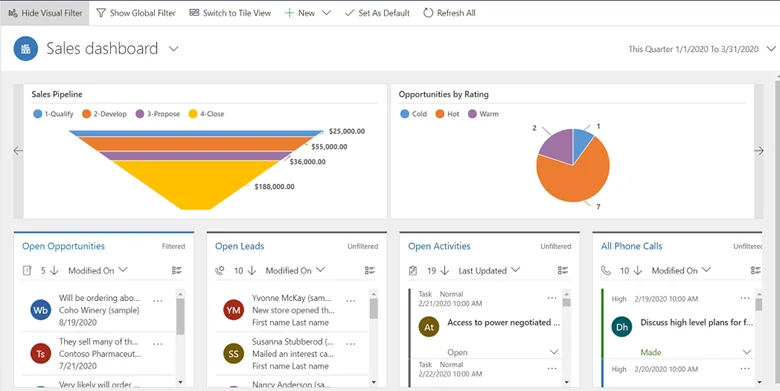
This unified data layer is what enables guided selling experiences such as Sales Accelerator in Dynamics 365. Instead of relying on manual prioritization, sellers are presented with a structured worklist, recommended next actions, and sequenced engagement steps based on real-time customer signals.
Key Takeaways
- A unified customer profile ensures every team works from the same data
- Real-time data enables more relevant and timely customer interactions
- Sales Accelerator helps prioritize high-value and at-risk accounts
- Guided next actions improve consistency across the sales process
- Data-driven engagement reduces missed opportunities and follow-up gaps
Related Read: : Dynamics 365 Implementation Cost
2. Move From Reactive to Predictive Customer Management
Traditional CRM workflows are reactive. Teams respond after issues surface, whether that is a missed renewal, declining engagement, or a support escalation.
Effective CRM strategies introduce a predictive layer that identifies risk earlier and enables timely intervention.
In Microsoft Dynamics 365, churn prediction models analyze behavioral patterns such as reduced engagement, changes in purchase frequency, delayed responses, or increased support activity. These signals are used to generate churn risk scores at the account level, allowing teams to identify at-risk customers before disengagement becomes visible.
Microsoft Copilot surfaces these insights directly within the CRM workflow, helping teams prioritize accounts based on both churn risk and potential value. This enables a more targeted approach, where high-risk and high-value customers receive focused attention.
More importantly, predictive CRM is not just about identifying risk. It is about guiding action. Based on the risk profile, teams can trigger specific interventions such as proactive outreach, service adjustments, or targeted offers at the right point in the customer lifecycle.
Key Takeaways
- Churn models use behavioral and engagement signals to detect early risk
- Risk scoring helps prioritize high-value and at-risk accounts
- Copilot surfaces insights within day-to-day workflows
- Predictive CRM connects insight to action through timely interventions
- Early intervention improves retention and customer lifetime value

3. Coordinate Customer Interactions Across the Lifecycle
Customers experience your organization as one entity, but most internal teams operate independently.
From our experience, this is where many retention issues originate. Marketing, sales, and service often engage the same customer without coordination, leading to poorly timed or conflicting interactions. A customer may receive a promotional offer while dealing with an unresolved support issue, or be contacted repeatedly by different teams without context.
Effective CRM strategies address this by aligning interactions across the customer lifecycle and ensuring that each engagement is informed by what has already happened.
In Microsoft Dynamics 365, this coordination is supported through unified timelines, cross-channel journey orchestration, and shared visibility across teams. More importantly, these capabilities allow organizations to sequence interactions more effectively, ensuring that communication is relevant, timely, and aligned with the customer’s current context.
This shift moves CRM from managing individual touchpoints to managing the overall customer experience.
Key Takeaways
- Coordinated interactions prevent conflicting or poorly timed outreach
- Sequencing touchpoints improves relevance and engagement
- Unified timelines ensure all teams share the same customer context
- Cross-channel orchestration reduces friction across the journey
- Better coordination leads to stronger customer experience and lower churn
4. Use Automation to Improve Timing and Consistency
Automation should improve how and when teams engage with customers, not simply increase the volume of outreach.
In many organizations, automation is still rule-based. Messages are triggered based on fixed conditions without considering the broader customer context. This often results in poorly timed communication, such as promotional outreach during an unresolved support issue or repeated follow-ups that do not reflect recent interactions.
Effective CRM strategies use automation to improve timing, sequencing, and relevance. Instead of isolated triggers, interactions are coordinated based on customer behavior, engagement signals, and lifecycle stage.
This capability is delivered in Microsoft Dynamics 365 through orchestrated customer journeys and workflows that adjust based on real-time signals. Microsoft Copilot supports decision-making with contextual communication, while AI agents ensure consistent execution across interactions.
This approach moves automation beyond task execution toward guided engagement. Instead of simply sending messages, the system determines what should happen next and ensures that actions are aligned with the customer’s current context.
Key Takeaways
- Automation improves timing, sequencing, and consistency across interactions
- Poorly timed outreach can negatively impact customer experience and engagement
- AI-driven workflows adapt to real-time customer behavior and signals
- Copilot enables contextual, personalized communication at scale
- AI agents support execution and ensure continuity across the lifecycle
5. Establish Continuous Customer Feedback and Visibility
Understanding customer sentiment in real time is critical for retention, but visibility alone is not enough. The real value comes from how quickly teams can act on that insight.
Effective CRM strategies create continuous feedback loops by capturing signals across support interactions, engagement patterns, and customer behavior. These signals help build an ongoing view of customer health rather than relying on periodic surveys or delayed reporting.
Within Microsoft Dynamics 365 Customer Service, Microsoft Copilot surfaces patterns such as rising ticket volume, repeated issues, or declining sentiment directly within the workflow. Combined with analytics and customer health scoring, this allows teams to identify early warning signs and respond before dissatisfaction turns into churn.
This shifts feedback from a reporting function to an operational one, where insight directly informs intervention.
Key Takeaways
- Continuous feedback builds a real-time view of customer health
- Early signals such as sentiment decline and ticket patterns indicate churn risk
- Copilot highlights trends directly within service workflows
- Teams can move from insight to action without delay
- Proactive intervention improves retention outcomes
6. Improve Data Quality Before Scaling CRM Capabilities
Data quality remains one of the most common barriers to CRM success, and it is often overlooked until systems begin to underperform.
From our experience, most issues with automation, reporting, and AI-driven recommendations can be traced back to incomplete, outdated, or duplicated data. When the underlying data is unreliable, even well-designed CRM processes fail to deliver consistent results.
Effective CRM strategies treat data quality as a foundational capability rather than a supporting task. This includes establishing clear data standards, maintaining consistency across systems, and ensuring that customer records remain accurate over time.
Within Microsoft Dynamics 365, data integrity is supported through validation rules, duplicate detection, and enrichment capabilities assisted by Microsoft Copilot. These controls help maintain a reliable data layer that supports reporting, automation, and predictive models.
Without this foundation, capabilities such as churn prediction, customer scoring, and automated workflows become less effective, as they rely directly on the quality of the data being used.
Key Takeaways
- Data quality directly impacts the reliability of AI and predictive models
- Duplicate and incomplete records lead to inconsistent customer experiences
- Data governance ensures accuracy across systems and teams
- Copilot-assisted enrichment helps maintain up-to-date customer records
- Strong data foundations enable more effective automation and decision-making
7. Use AI and Agents to Guide Actions at Scale
AI delivers the most value when it becomes part of how decisions are made and executed across the customer lifecycle.
Effective CRM strategies use AI to connect insight with action. Instead of relying on dashboards or manual analysis, AI models continuously evaluate customer data to identify churn risk, engagement opportunities, and the most relevant next step.
Within Microsoft Dynamics 365, this takes the form of embedded intelligence that combines churn prediction, customer scoring, and behavioral signals to guide engagement. Microsoft Copilot surfaces recommended actions directly within the workflow, while AI agents support execution by handling tasks such as follow-ups, research, and routine outreach.
This creates a more coordinated model of engagement, where teams are guided toward the right action at the right time rather than deciding each step independently.
Over time, as outcomes are fed back into the system, these models improve. This allows organizations to move toward a more adaptive approach, where decisions are continuously refined based on real-world results.
Key Takeaways
- AI connects prediction with action through guided decision-making
- Churn signals and scoring help prioritize engagement
- Copilot surfaces next steps within daily workflows
- AI agents support execution and consistency at scale
Ready To Explore How A CRM System Can Transform Your Business?
Request a personalized CRM consultation with AlphaBOLD's experts today and take the first step towards a more efficient, customer-centric business strategy.
Request a ConsultationTurning CRM Strategy Into Execution with AlphaBOLD
Most organizations understand what effective CRM strategies require. The challenge is execution.
From a practitioner perspective, CRM initiatives often fall short not because of platform limitations, but because data remains fragmented, workflows are misaligned, and teams lack a coordinated approach to customer engagement.
This is where the idea of the “next best experience,” highlighted by McKinsey & Company, becomes critical. It is not just about predicting customer behavior. It is about ensuring that every interaction is relevant, timely, and aligned with the customer’s current context.
At AlphaBOLD, CRM is approached as a connected system that brings together data, decision-making, and execution. In practice, this includes:
- Unifying customer data across CRM, ERP, and customer touchpoints
- Designing workflows that align sales, marketing, and service teams
- Embedding Copilot and AI capabilities into day-to-day processes
- Enabling agent-assisted execution for follow-ups and engagement
- Supporting adoption to ensure teams consistently use the system
The result is not just better visibility, but more consistent and coordinated customer engagement at scale.
Conclusion
Customer retention rarely breaks in one place. It slips through small gaps in how customers are engaged over time.
What we see in practice is not a lack of activity, but a lack of coordination. Messages go out at the wrong time, issues are handled in isolation, and teams make decisions without a full view of the customer. The result is an experience that feels inconsistent, even when each interaction works on its own.
The strategies in this article address that directly. When customer data is connected, when interactions are aligned across teams, and when timing is guided by real signals, engagement becomes more relevant and more consistent. That is what improves retention.
This is where effective CRM strategies make a difference. The shift is not about doing more. It is about making each interaction count. When organizations focus on context, timing, and coordination, retention becomes a natural outcome of how the business operates.
FAQs
CRM (Customer Relationship Management) software centralizes customer data, interactions, and communication history in one platform. It helps businesses retain customers by enabling personalized outreach, proactive service, and early identification of at-risk accounts. In 2026, CRM platforms like Microsoft Dynamics 365 also incorporate AI and Copilot capabilities that automate retention workflows surfacing churn signals, triggering re-engagement sequences, and recommending next-best actions without manual intervention.
CRM systems improve customer retention rates by up to 27% according to Aberdeen Group research. 47% of CRM users report a significant impact on both customer satisfaction and retention. Businesses that adopt AI-powered CRM capabilities see an additional 15% increase in repeat sales and customer retention through hyper-personalization and organizations using AI within CRM are 83% more likely to exceed their sales goals.
On average, businesses earn $8.71 for every $1 spent on CRM software (Nucleus Research). When properly implemented, CRM ROI can increase to 245%. Businesses using CRM report a 300% increase in lead conversion rates, a 16% boost in customer retention, and a 21% rise in agent productivity. Sales teams also save 4–5 hours per week per rep by eliminating manual data entry and administrative tasks.
CRM automation executes predefined rule-based sequences for example, sending a follow-up email 3 days after a demo. Agentic AI goes further: it can autonomously plan and execute multi-step workflows, adapt based on context, and take actions across multiple systems without a human initiating each step. In Dynamics 365, the Sales Close Agent and Sales Qualification Agent are examples of agentic AI they research leads, personalize outreach, flag deal risks, and follow up on opportunities without waiting for rep input. Agentic AI is not a replacement for human judgment; it handles execution while humans handle decisions.
Dynamics 365 Copilot improves retention through several mechanisms: it surfaces at-risk account signals from engagement and support data, drafts personalized re-engagement communications based on the customer’s actual history, generates call summaries and next-step recommendations after customer meetings, and automates follow-through on renewal and upsell workflows. Copilot draws from both CRM data and Microsoft 365 signals Outlook emails, Teams meetings, SharePoint documents to give sales and service reps a complete context view without manual data aggregation. Sellers using Copilot report spending up to 40% less time on administrative tasks.
The most common reasons are poor user adoption, inadequate training, and most critically poor data quality. 76% of CRM users report that less than half of their organization’s CRM data is accurate and complete. This data quality problem is the primary reason AI-powered CRM features underperform: the models are only as reliable as the data they draw from. Firms that invest in a clean, unified data layer using tools like Dynamics 365 Customer Insights and Dataverse before scaling automation and AI consistently outperform those that bolt AI onto fragmented data.
For B2B retention, the highest-value CRM features are: account health scoring (combining support history, engagement, and payment data into a single retention signal), renewal pipeline tracking with automated reminders and propensity scoring, case escalation workflows that surface unresolved issues to account managers before they affect renewal conversations, and executive business review (EBR) automation that compiles usage, performance, and ROI data into presentation-ready formats. Microsoft Dynamics 365 Customer Service and Customer Insights together cover all of these natively, with Copilot available to generate the narrative summaries and next-best-action recommendations on top of the data.
Both platforms have strong retention capabilities, but the key differentiator in 2026 is ecosystem integration. Dynamics 365 is natively integrated with the Microsoft 365 suite Outlook, Teams, SharePoint, Power BI, and Azure which means customer signals from email, meetings, and documents flow into the CRM automatically. For firms already operating on Microsoft infrastructure, this eliminates the data integration overhead that often limits Salesforce deployments. Forrester named Microsoft a Leader in The Forrester Wave: CRM, Q1 2025, specifically recognizing its unified platform and AI capabilities. Salesforce holds a 23.9% global market share and remains the dominant standalone CRM, but Microsoft’s integrated stack gives it a structural advantage for retention use cases that require cross-platform data.
Explore Recent Blog Posts




Related Posts