
Introduction
CRM systems sit at the center of sales and marketing operations. They capture pipeline activity, customer interactions, campaign performance, and revenue signals that leadership teams rely on to understand what is happening across the business. As organizations grow, so does the volume of data flowing through these systems.
Yet having access to data does not automatically translate into better decisions. Many organizations invest heavily in CRM reporting but still struggle to use insights consistently across sales and marketing teams. Reports exist, dashboards are shared, and metrics are tracked, but the connection between analytics and day-to-day decision-making remains uneven.
This blog explores why CRM analytics often fails to deliver the clarity organizations expect, and how modern analytics approaches are changing that equation. It examines the structural limitations of traditional CRM reporting, the role analytics plays across the revenue lifecycle, and how Power BI for CRM analytics helps organizations move from static reporting to insight-driven decision support.
The Evolution of CRM Analytics: From Reports to Decision Support
Traditional CRM analytics was designed for reporting. Dashboards summarized historical activity, and periodic reports explained outcomes after the fact. This model delivered visibility, but it did not consistently support timely decision-making. By the time insights reached leadership, conditions had often already changed.
Static dashboards are no longer sufficient because sales and marketing decisions happen continuously. Pipeline movement, deal momentum, campaign performance, and customer engagement shift in real time. Analytics that looks backward cannot guide teams operating in the present.
Key limitations of report-driven CRM analytics include:
- Insights arriving too late to influence outcomes
- Metrics explaining what happened, not what is changing
- Dashboards existing outside daily sales and marketing workflows
- Decision-making relying on interpretation rather than direction
Modern CRM analytics shifts the focus from historical reporting to real-time and forward-looking insight. Instead of asking what happened last quarter, teams need to understand what is happening now, where performance is trending, and which actions require immediate attention. This shift transforms analytics from a review tool into a decision support capability.
As analytics matures, it becomes embedded directly into CRM workflows. Insights surface during pipeline reviews, forecasting discussions, and campaign optimization rather than in separate reporting sessions. Power BI for CRM analytics enables this transition by aligning data, context, and insight with how sales and marketing teams actually operate.
Why CRM Data Remains Fragmented Across Sales and Marketing
Despite advances in CRM platforms and analytics tools, data fragmentation remains a persistent challenge. Most organizations do not struggle with data collection. They struggle with coordination, ownership, and consistency across the systems and teams responsible for revenue.
Sales and marketing often operate within the same CRM environment but view and manage data through different lenses. Each team optimizes for its own objectives, timelines, and success metrics. Over time, this creates multiple versions of the truth within the same system.
Common Drivers of CRM Data Fragmentation Include:
- Separate ownership of sales, marketing, and revenue operations data
- Disconnected tools for CRM, marketing automation, customer service, and finance
- Inconsistent definitions of pipeline stages, lead status, and attribution
- Customizations introduced without shared governance
The impact of this fragmentation goes beyond reporting inconvenience. When data definitions vary and context is missing, analytics loses credibility. Forecasts are questioned, pipeline reviews turn into reconciliation exercises, and teams hesitate to act on insights they do not fully trust.
Fragmentation also slows decision-making. Analysts spend time stitching data together instead of interpreting it. Leaders wait for confirmation instead of acting decisively. Opportunities to course-correct early are missed because signals arrive late or lack confidence.
Addressing this challenge requires more than connecting systems. It requires aligning data models, ownership, and analytics around shared business outcomes. Without that alignment, even sophisticated analytics tools struggle to deliver clarity.
Unlock the Power of CRM Analytics
Enhance your sales and marketing strategies with actionable insights using Power BI for CRM analytics. See the difference it makes.
Request a Demo todayThe Role of Power BI in Modern CRM Analytics
Solving CRM analytics challenges does not start with adding more dashboards. It starts with creating a shared analytical foundation that connects data, context, and decision-making across sales and marketing. This is where Power BI plays a distinct role within modern CRM environments.
Power BI extends CRM analytics beyond surface-level reporting by enabling organizations to work from consistent data models and shared definitions. Instead of each team interpreting CRM data differently, analytics is built around aligned metrics that reflect how the business actually operates.
In a modern CRM analytics architecture, Power BI supports:
- A unified view of CRM data across sales, marketing, and service
- Standardized definitions for pipeline, performance, and attribution
- Analytical models that support trends, patterns, and risk signals
- Insight delivery that scales without duplicating reports
The value comes from how analytics is designed, not how many visuals exist. When reporting is structured around business questions rather than isolated metrics, analytics becomes easier to trust and easier to act on. This shift reduces time spent reconciling numbers and increases confidence during decision-making moments.
Power BI for CRM analytics works best when positioned as a decision layer rather than a reporting add-on. It enables organizations to move from fragmented snapshots to a connected understanding of performance, creating the conditions for faster alignment, clearer accountability, and more effective action across revenue teams.
Embedded CRM Analytics Across the Revenue Lifecycle
CRM analytics delivers the most value when it is embedded into the moments where revenue decisions are made. When insights live outside daily workflows, adoption drops and analytics becomes reactive. Embedded analytics changes this by bringing context and signals directly into how sales and marketing teams operate.
Across the revenue lifecycle, embedded CRM analytics supports decisions as they happen, not after outcomes are finalized. Instead of switching between systems or waiting for reports, teams engage with insights in real time, within the same tools they already use.
Key Areas Where Embedded Analytics Drives Impact Include:
- Pipeline management: Visibility into deal progression, velocity, and risk during pipeline reviews
- Forecasting: Early signals that highlight gaps, overconfidence, or slippage before forecasts lock
- Campaign performance: Immediate feedback on which initiatives influence pipeline and revenue
- Customer engagement: Insight into behavior patterns that inform retention and expansion efforts
By embedding analytics into these workflows, organizations reduce the gap between insight and action. Sales leaders can intervene earlier, marketers can adjust campaigns faster, and revenue teams can align around shared signals instead of post-hoc explanations.
Embedded analytics also improves consistency. When insights are surfaced in the same context for all stakeholders, interpretation becomes more aligned. This reduces friction during reviews and shifts conversations from debating numbers to deciding next steps.
This transition marks a critical evolution in CRM analytics. Analytics is no longer a separate reporting function. It becomes an operational capability that supports decisions across the full revenue lifecycle.
Transform Your Data into Insights
Discover how integrating Power BI with your CRM can revolutionize your data analysis and decision-making process. Start your journey today.
Request a Demo todayTurning CRM Insights into Action
CRM analytics only delivers value when it changes behavior. Many organizations have access to insights, but few consistently act on them. The gap is rarely technical. It is operational. Insights exist, but they are not delivered at the right time, in the right context, or to the right decision-makers.
Actionable CRM analytics shifts the focus from visibility to intervention. Instead of reviewing performance after outcomes are locked, teams use analytics to identify risk early, course-correct faster, and align around shared signals. This requires analytics to be embedded into daily workflows rather than treated as a separate reporting exercise.
When CRM insights are designed to drive action, organizations see measurable improvements in:
- Decision velocity: Faster responses to pipeline risk, stalled deals, and underperforming campaigns
- Adoption: Insights surfaced during real work, not buried in reports
- Alignment: Shared definitions and metrics reduce debate and increase confidence
- Accountability: Teams act on the same signals instead of reconciling numbers
This shift is not theoretical. It is already visible in organizations that have modernized how CRM data supports operations.
Further Reading: Top Power BI Dashboard Design Tips for Clear and Impactful Visuals
Proof in Practice: Actionable CRM Analytics
The impact of embedded CRM analytics becomes clear when organizations move beyond reporting and redesign how data supports daily operations. A recent example is the transformation of the Boston Water & Sewer Commission, which modernized decades-old, paper-heavy processes by consolidating systems on Microsoft Dynamics 365.
Prior to modernization, the organization relied on an outdated customer information system that created operational silos across billing, customer service, and field operations. Manual workflows dominated, with most service orders processed on paper. Data existed, but it was slow, fragmented, and difficult to act on.
By moving to a unified Dynamics 365 platform and introducing automated workflows, BWSC significantly reduced manual effort, improved data flow, and enabled faster decision-making across teams. Billing processes were automated, customer inquiries were resolved more quickly, and employees gained access to consistent, trusted data for operational and financial insight.
Analytics played a supporting but critical role. With Power BI, reporting became more accessible and self-service, reducing dependency on centralized teams and enabling accountability across departments. More importantly, the organization created a foundation for AI-assisted support, automation, and future innovation without adding complexity to daily work.
This type of transformation illustrates a key point: when CRM analytics is embedded into operational workflows and supported by aligned data models, organizations stop debating reports and start acting on insight.
Intelligent CRM Analytics with AI and Automation
Once CRM analytics is embedded into daily workflows, organizations can move beyond descriptive insight to intelligent guidance. AI and automation extend analytics by helping teams anticipate risk, recognize patterns, and prioritize action without increasing complexity.
Intelligent analytics reduces manual interpretation. Instead of reviewing multiple dashboards, teams receive focused signals that highlight what needs attention and why.
Key capabilities enabled by AI-assisted CRM analytics include:
- Early risk detection: Identifying stalled deals, declining engagement, or forecast gaps sooner
- Pattern recognition: Surfacing trends across pipeline, customer behavior, and campaign performance
- Predictive insight: Anticipating outcomes based on historical and real-time data
- Guided focus: Directing teams to high-impact opportunities instead of overwhelming them with metrics
As CRM analytics becomes more intelligent, governance becomes essential. AI-driven insights rely on consistent data models, clear permissions, and trusted definitions. Without these foundations, automation amplifies noise. With them, clarity and confidence are reinforced.
This balance is where Power BI for CRM analytics delivers value. By operating on shared data models and existing security controls, intelligent analytics scales safely across teams while keeping insights contextual, auditable, and aligned with real decision-making.
When applied intentionally, AI and automation do not complicate CRM analytics. They sharpen it. Organizations move from reacting to outcomes to anticipating them, without sacrificing control over data quality, accountability, or risk.
Further Reading: AI in CRM: Exploring Microsoft Dynamics 365 Benefits
Drive Business Growth with Power BI
Leverage the full potential of your customer data with Power BI for CRM analytics. Optimize your operations and drive sustainable growth.
Request a Demo today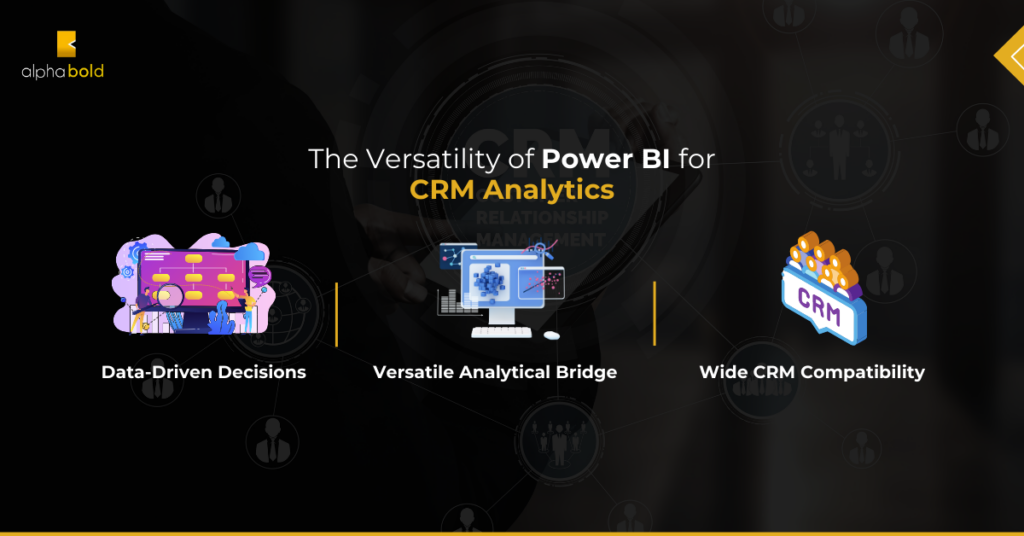
Conclusion
CRM analytics succeeds or fails based on how well it supports decisions. When analytics is treated as a reporting layer, it produces visibility without clarity. When it is designed as part of the operating model, it becomes a strategic asset that guides action across sales and marketing.
Organizations that get this right move beyond static dashboards and fragmented metrics. They align data models, embed insight into daily workflows, and use intelligence to anticipate risk rather than react to outcomes. The result is faster decision-making, stronger alignment across teams, and greater confidence in the data driving revenue conversations.
Power BI for CRM analytics delivers value when it is implemented with this intent. Not as a standalone reporting tool, but as part of a broader analytics strategy that prioritizes trust, relevance, and action. When analytics is grounded in governance, integrated with CRM workflows, and enhanced by intelligent automation, it stops being a passive output and starts shaping how the business operates.
For organizations looking to strengthen sales and marketing performance, the question is no longer whether CRM analytics is necessary. The question is whether it is designed to drive decisions that matter.
Experience the Future of CRM Analytics
Take your sales and marketing to the next level with advanced CRM analytics. Learn how Power BI can help you succeed.
Request a Demo todayExplore Recent Blog Posts