The Role of AI in Manufacturing Industry

Table of Contents
Introduction
AI in manufacturing is now part of how companies manage uptime, quality, production planning, inventory, supply chain risk, and customer commitments. It helps teams predict failures, detect defects, forecast demand, optimize resources, and make faster decisions across the factory floor and business systems.
For manufacturing leaders, the real value comes from choosing the right use cases and connecting AI insights to the systems teams already use, including ERP, CRM, MES, inventory, procurement, and service platforms. Without that connection, AI often remains limited to reports and dashboards rather than improving daily operations.
This blog breaks down the key benefits, use cases, examples, trends, and challenges of AI in manufacturing, focusing on how manufacturers can turn operational data into measurable business outcomes.
Key Takeaways
- AI in manufacturing helps improve uptime, quality control, forecasting, inventory planning, production scheduling, supply chain visibility, and customer-facing workflows.
- The highest-value use cases are tied to measurable outcomes, such as reduced downtime, lower waste, better margins, faster decisions, and stronger service response.
- AI delivers stronger results when it connects with ERP, CRM, MES, inventory, procurement, service, and shop-floor systems instead of staying limited to standalone dashboards.
- Manufacturers should start by identifying the right operational problem, assessing data readiness, and building AI workflows that can scale across teams and systems.
What Is AI in Manufacturing?
AI in manufacturing is the use of machine learning, computer vision, predictive analytics, generative AI, and automation to improve how products are planned, produced, inspected, maintained, and delivered. It helps manufacturers turn operational data into faster decisions across production, quality, inventory, supply chain, and service workflows.
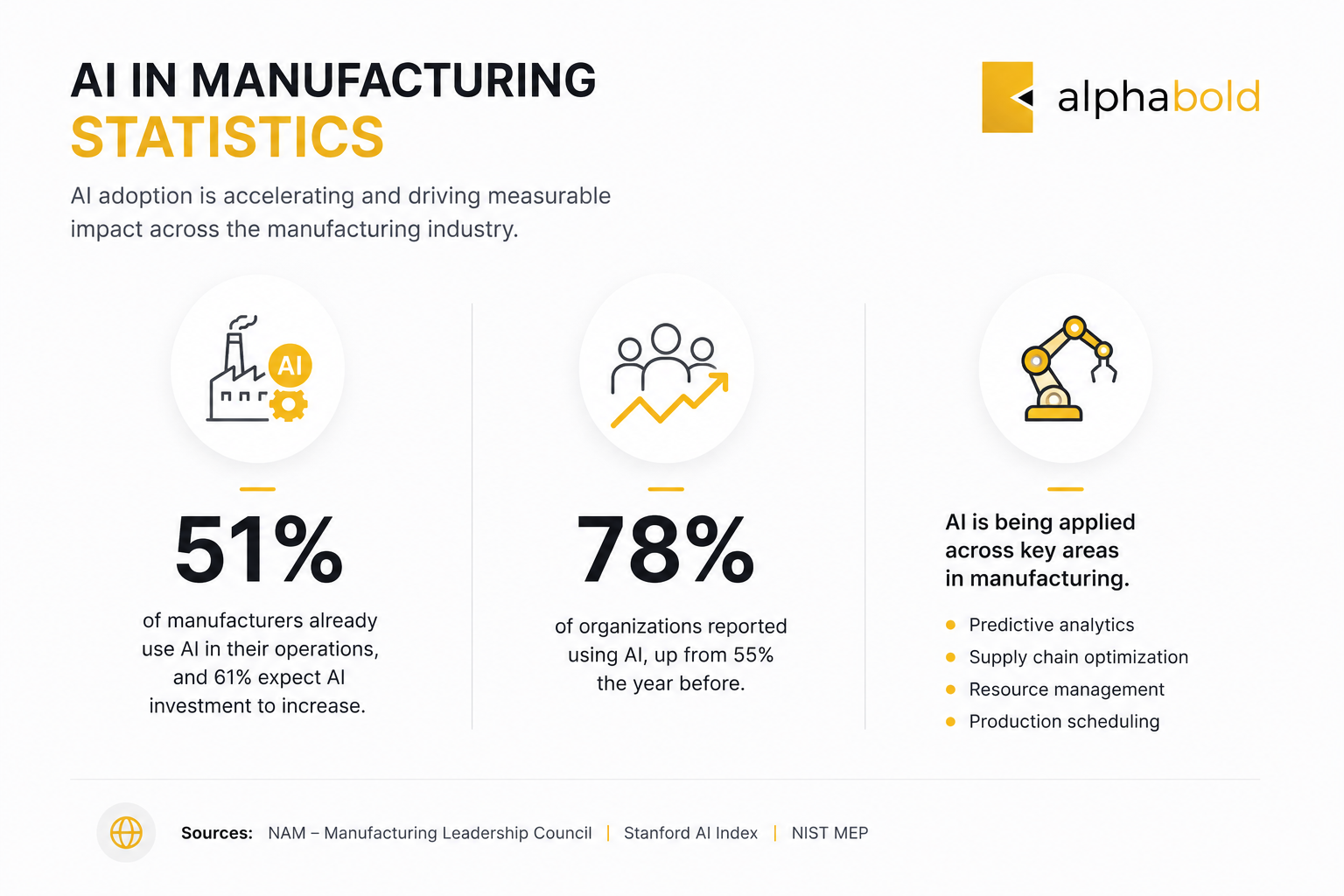
NIST MEP frames AI in manufacturing around practical applications such as predictive analytics, supply chain optimization, resource management, production scheduling, and digital twins. Recent industry data also shows that AI adoption is becoming more operational and investment-driven, with 51% of manufacturers already using AI in their operations and 61% expecting AI investment to increase. Broader enterprise adoption is rising as well, with 78% of organizations reporting AI use, up from 55% the year before.
These numbers point to the same reality: the value of AI depends not only on the model, but also on how well it connects with ERP, CRM, MES, and shop-floor systems. With that foundation in mind, here are the use cases already delivering results across the manufacturing industry:
What Are the Benefits of AI in Manufacturing?
AI creates value in manufacturing when it improves the decisions and workflows that affect production, cost, quality, and customer commitments. The strongest benefits usually come from applying AI to specific operational problems and connecting the results to ERP, CRM, MES, supply chain, and service systems.
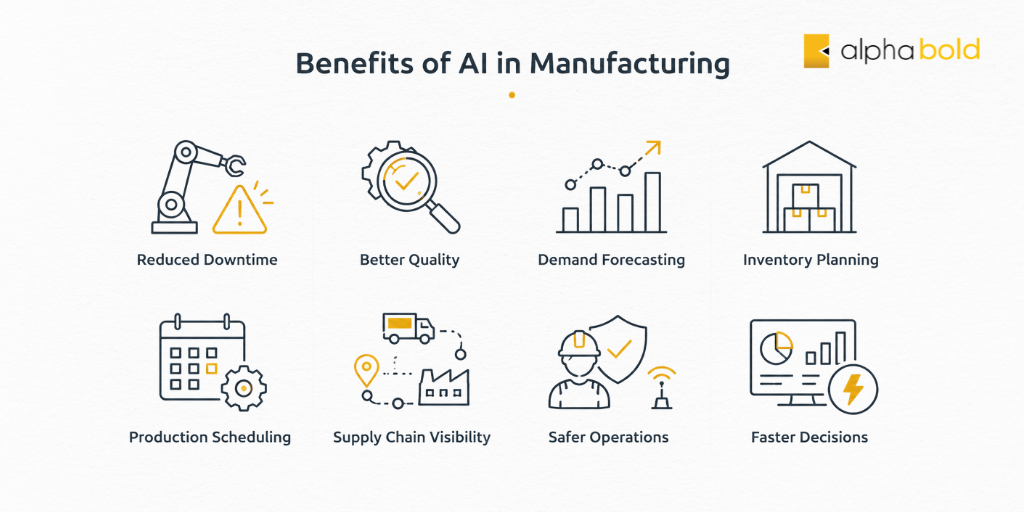
The main benefits include:
Reduced downtime: AI can detect failure patterns earlier, helping teams plan maintenance before equipment issues disrupt production.
Better quality control: Computer vision and anomaly detection can identify defects, inconsistencies, and process issues earlier in the production cycle.
More accurate demand forecasting: AI can combine sales history, demand signals, seasonality, and external factors to improve planning accuracy.
Smarter inventory planning: AI can help predict stockouts, excess inventory, raw material needs, and replenishment timing.
Improved production scheduling: AI can support better scheduling decisions by factoring in capacity, labor, machine availability, and supplier constraints.
Stronger supply chain visibility: AI can help identify supplier delays, logistics risks, and procurement issues before they affect customer commitments.
Safer operations: AI-enabled sensors, vision systems, and cobots can help teams monitor unsafe conditions and reduce manual risk.
Faster business decisions: AI can turn operational data into recommendations that help teams act faster across production, service, finance, and customer operations.
How Is AI Used in Manufacturing?
AI is used in manufacturing to improve how teams predict problems, plan production, inspect quality, manage inventory, support workers, and respond to changes from customers or suppliers. The most useful applications are not isolated tools. They are connected workflows where AI insights flow into ERP, CRM, MES, supply chain, service, and shop-floor systems.
1. Predictive Maintenance with Context:
Predictive maintenance uses sensor data, machine history, operating conditions, and usage patterns to identify equipment issues before they cause downtime. Instead of relying solely on fixed maintenance schedules, manufacturers can use AI to predict when a part is likely to fail and plan service accordingly.
- Example: A production-line motor exhibits unusual vibration and temperature patterns. AI flags the risk, and the ERP system creates a maintenance work order before the equipment fails.
- Business impact: Less unplanned downtime, longer asset life, better maintenance planning, and fewer production delays.
You may also like: Introduction to Predictive Maintenance Solution
2. Vision-Based Quality Inspection:
Computer vision helps manufacturers inspect products, parts, labels, packaging, and assembly quality in real time. AI models can detect defects, inconsistencies, surface issues, missing components, or incorrect measurements faster and more consistently than manual checks in high-volume environments.
- Example: A vision AI system detects scratches, dents, or alignment issues on a product before it moves to packaging or shipment.
- Business impact: Lower scrap, fewer recalls, reduced rework, stronger quality control, and better customer satisfaction.
3. AI-Augmented Demand Forecasting:
AI improves demand forecasting by analyzing historical sales, seasonality, customer behavior, market signals, and supply chain variables. This helps manufacturers plan production around expected demand instead of relying only on static forecasts or manual estimates.
- Example: A manufacturer uses AI to predict demand changes across product lines and adjusts production planning before inventory becomes too high or too low.
- Business impact: Better production planning, fewer stockouts, lower excess inventory, and smarter procurement decisions.
4. Inventory Optimization:
AI helps manufacturers manage raw materials, finished goods, spare parts, and warehouse stock more accurately. It can identify patterns in usage, lead times, supplier performance, and demand changes to recommend when to reorder and how much inventory to hold.
- Example: AI detects that a critical material is likely to run short based on upcoming production orders and supplier lead times, then triggers a replenishment alert in the ERP system.
- Business impact: Lower carrying costs, fewer stockouts, better cash flow, and stronger supply chain resilience.
5. Production Scheduling and Planning:
AI can support production scheduling by analyzing machine availability, labor capacity, order priority, material readiness, and delivery timelines. This helps manufacturers adjust schedules faster when demand changes, machines go down, or supplier delays occur.
- Example: A manufacturer receives a high-priority order. AI reviews available capacity, material inventory, and machine schedules to recommend the best production slot.
- Business impact: Faster throughput, better capacity utilization, fewer bottlenecks, and improved on-time delivery.
6. Supplier Risk and Procurement Intelligence:
AI can help procurement teams identify supplier delays, pricing changes, quality issues, and contract risks before they affect production. By analyzing supplier performance and external signals, manufacturers can make better sourcing and purchasing decisions.
- Example: AI detects that a supplier has a pattern of late deliveries for a critical component and flags the risk before the next production cycle begins.
- Business impact: Fewer supply disruptions, better vendor management, stronger procurement planning, and improved customer commitments.
7. Energy Optimization:
Manufacturing operations often consume significant energy across machines, facilities, heating, cooling, and production lines. AI can analyze energy usage patterns and recommend ways to reduce waste without affecting output or quality.
- Example: AI identifies that certain machines consume more energy during specific operating windows and recommends schedule adjustments to reduce peak energy usage.
- Business impact: Lower operating costs, improved resource efficiency, and better support for sustainability goals.
8. Worker Safety and Human-Machine Collaboration:
AI-enabled sensors, cameras, and collaborative robots can help improve safety on the factory floor. These systems can identify unsafe movements, restricted-zone violations, equipment risks, or repetitive tasks that may increase worker strain.
- Example: A cobot adjusts its movement when a worker enters its operating area, while a vision system alerts supervisors to unsafe conditions near heavy machinery.
- Business impact: Safer operations, fewer workplace incidents, better labor support, and more flexible production environments.
9. Generative AI for Documentation and Engineering Support
Generative AI can help manufacturers create, summarize, and search technical documentation, maintenance instructions, SOPs, engineering notes, and training materials. It can also help technicians and managers find answers faster from large knowledge bases.
- Example: A maintenance technician asks an AI assistant for troubleshooting steps based on a machine error code, service history, and internal documentation.
- Business impact: Faster knowledge access, shorter training cycles, improved technician productivity, and better process consistency.
10. AI Agents for ERP, CRM, and Operations Workflows
AI agents can support multi-step workflows across manufacturing systems. Instead of only providing recommendations, agents can help summarize issues, trigger tasks, update records, draft follow-ups, and coordinate actions across ERP, CRM, service, procurement, and production systems.
- Example: A quality issue is detected for a specific batch. An AI agent summarizes the issue, checks affected orders, alerts customer service, and creates follow-up tasks in the CRM and ERP systems.
- Business impact: Faster response times, less manual coordination, better cross-functional visibility, and stronger operational accountability.
How Does AI in Manufacturing Connect With ERP and CRM Systems?
AI creates the most value in manufacturing when insights move beyond reports and into the systems teams use to run the business. That includes ERP, CRM solutions like Dynamics 365, MES, inventory, procurement, supply chain, field service, and customer service platforms.
For example, predictive maintenance insights can trigger ERP work orders, inventory checks, and technician scheduling. Demand forecasting can support procurement, production planning, and supplier negotiations. Quality alerts can notify customer service teams when a specific batch, order, or customer account may be affected. Inventory risk signals can prompt replenishment workflows before shortages disrupt production.
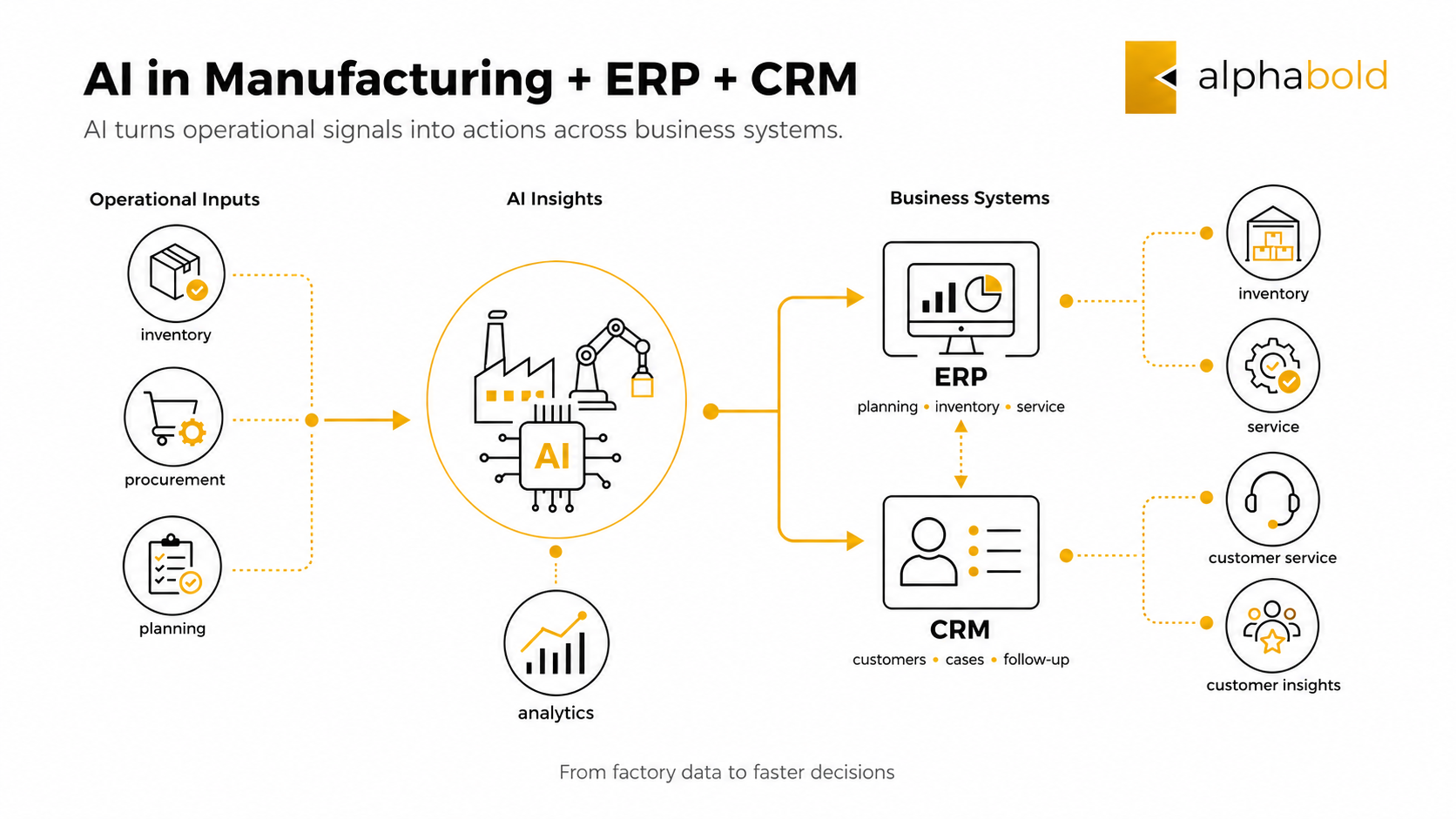
This connection matters because manufacturing decisions rarely sit in one system. A machine issue can affect production schedules, inventory availability, delivery timelines, customer commitments, and service follow-up. When AI is connected to ERP and CRM workflows, teams can move from insight to action faster, with less manual coordination across departments.
For manufacturers, the goal should not be to add AI as another standalone dashboard. The goal should be to build an operating layer where AI works with the systems that already shape daily decisions. That requires more than one successful use case. It requires reliable data from machines, suppliers, production lines, customers, and business systems; tools like digital twins and simulation to test scenarios before changes reach live operations; and clear governance for human review, model accuracy, security, and accountability.
This is especially important when AI recommendations affect safety, quality, compliance, or customer commitments. The more connected AI becomes, the more important it is to make sure the data, workflows, and decision rights behind it are just as strong as the model itself.
Ready to Make AI Work with Your ERP or CRM?
AI creates the most value when it is connected to the systems that already run your manufacturing operations. AlphaBOLD helps manufacturers identify practical AI use cases, assess data readiness, and connect AI insights with ERP, CRM, analytics, service, and operational workflows.
Request a ConsultationWhat Challenges Do Manufacturers Face When Adopting AI?
AI adoption in manufacturing becomes difficult when companies try to scale beyond one controlled use case. The challenge is rarely the model alone. It is the surrounding data, systems, people, governance, and workflows that determine whether AI becomes useful in daily operations.
Common challenges include:
- Disconnected and poor-quality data: Manufacturing data often sits across ERP, CRM, MES, SCADA, IoT, supplier systems, spreadsheets, and legacy databases. If that data is incomplete or poorly structured, AI outputs are harder to trust.
- Legacy system limitations: Older production, inventory, and planning systems may not support real-time AI workflows or easy integration.
- Unclear ownership: AI projects can stall when IT, operations, quality, supply chain, and finance teams do not share responsibility for the outcome.
- AI skills and workforce readiness: Teams need enough AI literacy to understand recommendations, review outputs, and apply them in real production environments.
- Workflow redesign: AI only creates value when alerts, work orders, approvals, escalations, and follow-ups are redesigned around the insight.
- Governance and accountability: Manufacturers need clear rules for human review, access control, model monitoring, data privacy, and decisions that affect safety, quality, compliance, or customers.
- Measuring ROI: AI outcomes should connect to metrics like downtime, scrap rate, forecast accuracy, inventory cost, on-time delivery, or service response time.
The manufacturers that see the strongest results treat AI adoption as a business transformation effort, not a software deployment.
You may also like: Building Next-Gen RAG Applications with Agentic AI
What It Means for Your Business?
For manufacturers, AI is no longer just a technology conversation. It is an operational decision. The real question is which use cases can improve uptime, quality, forecasting, inventory, service, and customer commitments, and whether your current systems can support them.
That is where AlphaBOLD can help. We work with manufacturers to identify the right AI opportunities, assess data readiness, and connect AI insights with the ERP, CRM, analytics, and operational systems that already run the business. Instead of adding another disconnected dashboard, we help teams build workflows that turn AI recommendations into measurable action.
Whether you are exploring predictive maintenance, demand forecasting, quality automation, inventory optimization, or AI agents for business workflows, the starting point should be clear: define the business problem, review the systems and data behind it, and build a roadmap that can scale across teams.
If you are evaluating where AI fits into your manufacturing operations, AlphaBOLD can help you move from scattered ideas to a practical implementation plan.

Frequently Asked Questions About AI in Manufacturing
Where Should Manufacturers Start With AI?
Manufacturers should start with one measurable operational problem, such as downtime, poor forecast accuracy, quality issues, inventory imbalance, or slow service response. From there, they should assess whether the right data exists, define success metrics, and choose a use case that can connect with existing ERP, CRM, MES, or supply chain workflows.
How Can Manufacturers Know If Their Data Is Ready for AI?
Manufacturing data is ready for AI when it is accessible, consistent, complete enough for the use case, and connected across the systems involved in the decision. For example, predictive maintenance may require machine sensor data, maintenance history, parts inventory, and service workflows. If that data is fragmented or unreliable, data readiness should come before AI deployment.
Should Manufacturers Build Custom AI or Use AI Built Into Existing Systems?
It depends on the use case, data complexity, and business goals. AI built into ERP, CRM, analytics, or cloud platforms can be a good starting point for common workflows like forecasting, reporting, service, and productivity. Custom AI may be needed when the manufacturer has specialized production processes, unique data sources, or highly specific automation requirements.
You may also like: The Complete Guide to Preparing Your Data for AI Success
Thinking about where AI fits into your operations?
If you are evaluating AI for maintenance, forecasting, quality, inventory, production planning, or customer-facing workflows, AlphaBOLD can help you prioritize the right use cases and build a roadmap around your existing systems.
Request a ConsultationConclusion
AI in manufacturing is most valuable when it solves a specific operational problem and connects the result to the systems teams use every day. Predictive maintenance, quality inspection, demand forecasting, inventory optimization, AI agents, and ERP-connected workflows can all improve performance, but only when the data, systems, and processes behind them are ready.
For manufacturers, the next step is not to adopt AI everywhere at once. It is to identify the highest-impact use cases, assess the data and workflows behind them, and build a practical roadmap that turns AI insights into measurable business outcomes.
AlphaBOLD helps manufacturers take that step with a clear focus on ERP, CRM, analytics, automation, and connected business systems.
Explore Recent Blog Posts